
Pain Management Medical Billing for Higher Revenue
If you’re like most pain management specialists, you chose this field to make a real difference in people’s lives. The last thing you wanted was to become an expert in pain management medical billing.
But here’s the reality we see every day: using a one-size-fits-all billing system for your pain management practice is like using a basic first-aid kit for complex spinal surgery. It might handle the simple stuff, but it completely falls apart when things get complicated.
And in your world, things are always complicated.
Those intricate procedures you perform? They demand equally precise pain management medical billing. A generic approach simply can’t navigate the specific codes, strict documentation rules, and frequent denials that are unique to your specialty. It’s not just inefficient—it’s a direct leak in your practice’s revenue stream.
The good news? Fixing this doesn’t just stop the leaks. It opens the valve to higher, more consistent revenue — especially when paired with a denial management strategy that prevents common claim rejections before they occur.


Why Pain Management Billing is a Specialty Unto Itself
Think of medical billing for pain management less like paperwork and more like a highly complex, diagnostic procedure — the kind that benefits from specialized medical billing services designed for your specialty. You wouldn’t use a general practitioner’s approach to treat a intricate nerve condition. In the same way, applying a standard billing process to your practice is a recipe for financial headaches.
Here’s the core of the issue: complexity. A typical family practice might deal with a handful of common codes each day. Your practice, however, navigates a minefield of intricate procedures where the slightest coding detail makes all the difference.
Let’s break down what makes your world so unique:
- The Code Conundrum: It’s not just about knowing CPT codes; it’s about understanding their subtle siblings. Is that injection a 64483 or a 64484? Choosing wrong doesn’t just mean a denial—it can trigger a payer audit. And when you add modifiers into the mix (59, 76, LT, RT), the combinations become endless. Getting this right requires a coder who thinks like a clinician.
- The “Why” Behind the Procedure: For a common cold, medical necessity is straightforward. For a series of epidural injections? You’re under a microscope. Payers demand a clear story in the documentation: the patient’s history, the exam findings, the failed conservative treatments, and the precise medical reason for this specific procedure, on this specific date. Without that narrative, even a perfectly coded claim will be denied.
- The Bundling Trap: This is where many general billers get caught. Procedures in pain management are often bundled together by National Correct Coding Initiative (NCCI) edits. Billing for two services that are considered part of one another is a fast track to a denial. Unbundling them correctly requires an expert who knows the rules inside and out.
In short, generic billing software and generalist billers lack the specific training for this high-stakes environment — which is why outsourcing your medical billing to a specialty-focused partner can dramatically improve accuracy and reimbursements. They see codes; a specialist sees the entire clinical and financial picture. And that distinction is what protects your revenue.
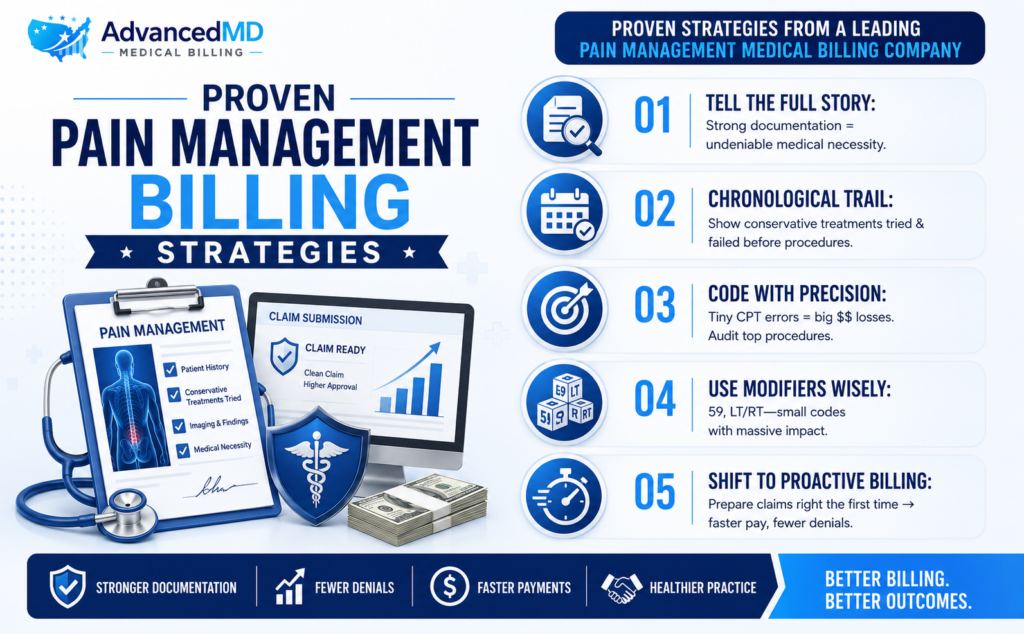
Proven Strategies from a Leading Pain Management Medical Billing Company
Okay, enough about the problems. You live those every day. Let’s talk about solutions.
At AdvancedMD Medical Billing, we’ve found that fixing pain management medical billing isn’t about magic. It’s about applying the same disciplined processes we use across all our healthcare revenue cycle management services. It’s about applying a disciplined, specialized approach to the very complexities that trip up general billers. It’s the difference between struggling with a tangled knot and knowing the one thread to pull to loosen it all.
Think of us as your practice’s clinical team for revenue health. We diagnose billing issues, prescribe targeted solutions, and monitor your financial vitals. Here are a few of the core strategies we use to protect and grow your revenue.
Mastering the Documentation Triad
This is our number one rule. Payers aren’t just approving a procedure; they’re approving the medical reason for it. Your documentation must tell a compelling story.
- Go Beyond the Pain Scale: Instead of just “patient rates pain 8/10,” document the impact like “Patients reports 8/10 pain, preventing them from picking up their grandchild or sitting through a meal” as this creates a powerful and undeniable picture of medical necessity.
- Build a Chronological Trail: Note the conservative therapies tried and failed (physical therapy, NSAIDs, etc.) before moving to injections, this shows a logical, justified progression of care. In our experience, a well documented history is your strongest shield against denials.
A Coder’s Eye: Avoiding Common & Costly CPT Mistakes
In pain management, there are no “close enough” codes. Using 64483 (injection, sciatic nerve) when you should have used 64484 (injection, sciatic nerve, with imaging) isn’t a simple error—it’s a $100+ mistake, multiplied by every patient.
- Understand the “What” and “How”: The specific approach—transforminal vs. interlaminar, with or without ultrasound guidance—dictates the code. Your coder must be able to read a procedure note and visualize exactly what the physician did.
- Audit Your Common Codes: Pull a report of your top 20 procedures. Are you consistently using the most specific, accurate codes? You might be surprised how often outdated or simplified codes linger in your system, quietly draining revenue.
The Modifier Matrix: 59, LT/RT, and Beyond
Modifiers aren’t just optional flags; they’re essential instructions for the payer.
- Modifier 59 (Distinct Procedural Service): This is the most powerful and most misused modifier. Use it to tell the payer, “These two procedures were separate and distinct.” But be warned—using it incorrectly is a red flag for auditors. The key is your documentation must support why they were distinct (e.g., different sites, separate incisions).
- Laterality Modifiers (LT/RT): Seems simple, right? But missing an LT/RT on a unilateral injection is a guaranteed denial. It’s a simple fix that has a massive impact on your clean claims rate.
Implementing these strategies requires a shift from a reactive billing process (submit a claim, see what happens) to a proactive one (prepare the claim to ensure it gets paid), this takes work, but the payoff is a smoother, more predictable revenue cycle that actually reflects the high level care you provide.
A Proactive Denial Management Framework for Pain Clinics
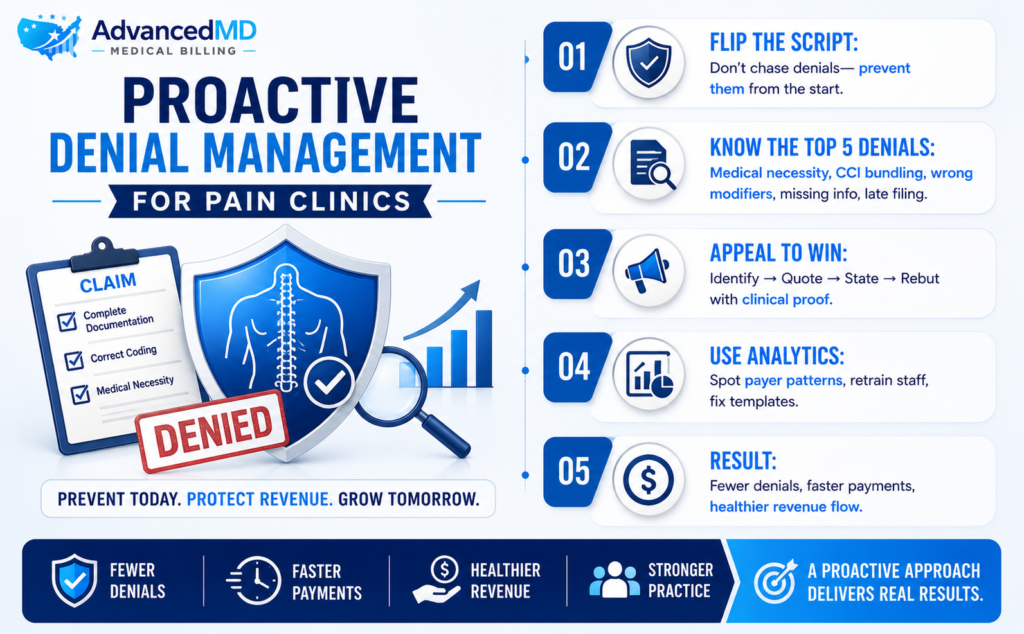
Most clinics treat denials like a game of whack-a-mole—they wait for one to pop up, then scramble to appeal it. It’s exhausting, expensive, and completely reactive. For your medical billing pain management to truly excel, you need to flip the script.
Stop chasing denials and start preventing them.
A proactive framework means you’re not just fixing errors; you’re predicting them and building claims that are bulletproof from the start. It’s the difference between constantly putting out fires and installing a superior sprinkler system. Here’s how we build that system.
Predicting the Top 5 Denials
You can almost set your watch by the following, and knowing them is your first line of defense.
- Lack of Medical Necessity: The payer’s rationale? “We don’t see enough proof that this complex procedure was needed.” They want a clear story from initial exam to final decision.
- Bundled Service (CCI Edits): Their logic? “Our rules state these two services are included in one another” and billing them separately without a valid modifier is a guaranteed denial.
- Incorrect Modifier: Here, they’re saying, “You used a modifier that doesn’t apply here, or you didn’t use one when you should have,” it’s a communication breakdown.
- Missing Information: Simple but brutal. “We can’t process this because [field X] is empty.” Often something simple like a referring provider NPI.
- Timely Filing: The hardest one to fight. “You submitted this claim outside our contractual deadline,” this is often a symptom of a slow, inefficient internal process.
The Appeals Playbook: Writing to Win
A strong appeal isn’t emotional; it’s a structured, evidence-based argument, ditch the angry letters. Use this formula instead:
- Identify: State the denial reason and claim number upfront.
- Quote: Directly cite the clinical notes from the patient’s record that support your case. For example: “As documented in the procedure note on 2026, the patient presented with…”
- State: Clearly restate why the service was medically necessary and correctly coded.
- Rebut: Politely but firmly reference the specific payer policy or clinical guideline that justifies the service.
The magic isn’t in the template—it’s in using it to showcase the clinical evidence that was already in your chart.
Leveraging Analytics for Denial Prevention
This is where you move from good to great. Your billing data isn’t just for tracking dollars; it’s a crystal ball.
Stop looking at denials as one-off events. Start grouping them. Is one payer consistently denying a specific code? Is a particular physician’s documentation style triggering more audits? Are most of your timely filing denials coming from one referring partner?
By analyzing the patterns, you can fix the root cause. You can retrain staff, update templates, or have informed conversations with payers before you submit another hundred claims, and you’re not just cleaning up messes, you’re stopping them from happening.
Leveraging MIPS and Value-Based Care as a Revenue Engine
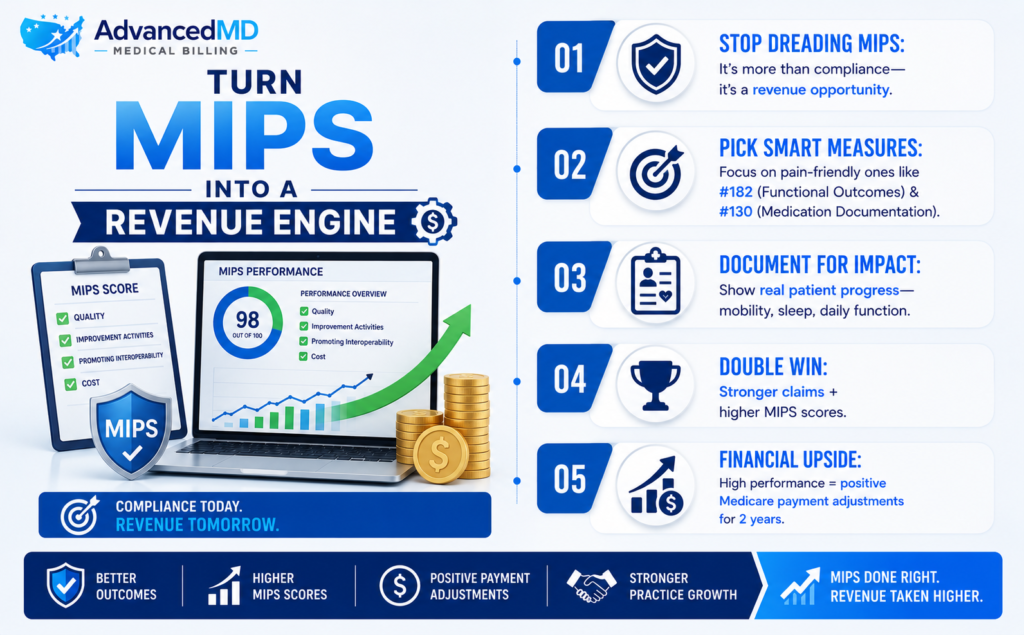
Let’s be real—when you hear “MIPS,” you probably think “government paperwork” and “compliance headache.” We get it. But what if we told you that treating MIPS and Value-Based Care as a strategic project could actually become a reliable revenue stream?
It’s true. While everyone else is scrambling to avoid penalties, you can be strategically earning rewards. This isn’t just about checking boxes for Medicare; it’s about building a practice that payers love to work with because you clearly demonstrate high-quality, efficient care. It’s about turning your clinical excellence into a financial advantage.
Selecting the Right MIPS Measures for Pain Management
Don’t try to boil the ocean, the key is focusing on measures that align naturally with your daily workflow. Think quality over quantity.
For pain management, measures like #182 (Functional Outcome Assessment) are a perfect fit—you’re already assessing patient function. Another strong candidate is #130 (Documentation of Current Medications). By tracking what you already do, you build a high score without the extra hassle.
Documenting for Outcomes, Not Just Payment
Shift your mindset. Instead of documenting just to justify a procedure code, document to tell the story of the patient’s functional journey.
Note their improved ability to walk, sleep, or return to work. This does two things brilliantly: it racks up points for MIPS and builds an ironclad case for medical necessity on your complex claims. You’re essentially getting paid twice for one good note.
The Financial Upside of High MIPS Performance
This is the best part. MIPS isn’t a break-even game. It’s a profit center.
The funds from those who perform poorly are redistributed to those who perform well. For the 2024 reporting year, a high score can mean a significant positive payment adjustment on all your Medicare Part B claims for two years. That’s not a bonus—it’s a direct, recurring ROI for delivering exceptional care.
Optimizing Your Entire Revenue Cycle: Beyond the Claim
Here’s a hard truth we’ve learned: you can have the world’s best biller, but if your front desk is overwhelmed, your revenue will still struggle.
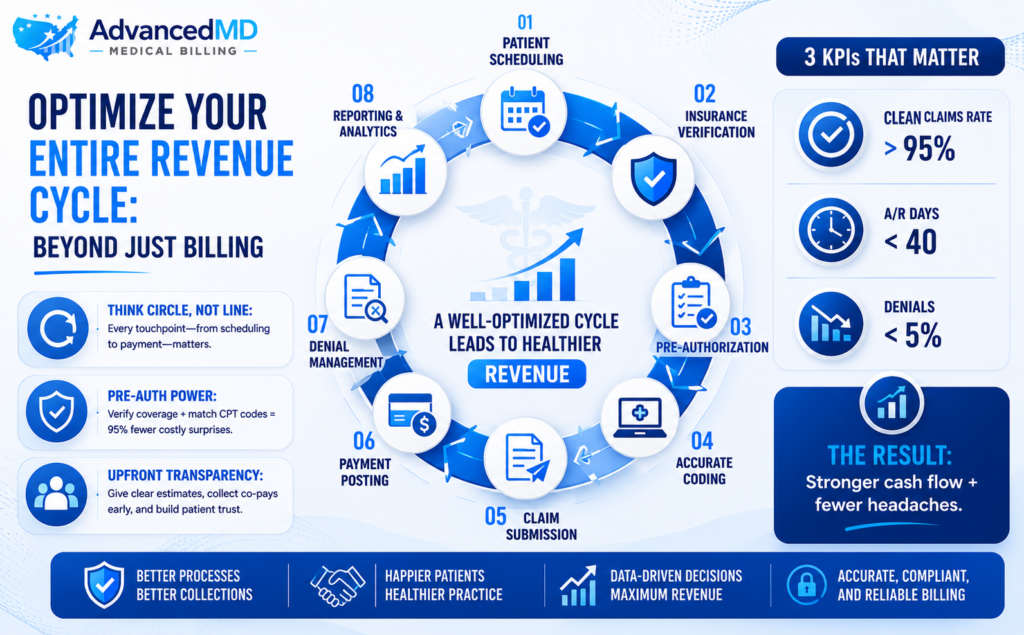
Think of your revenue cycle not as a line, but as a circle. Every touchpoint connects. A missed detail at the start doesn’t just create more work—it creates a leak that drains your practice’s financial health over time. Getting your pain management medical billing right means looking at the whole picture, from the moment a patient books an appointment to the day their final balance is zero.
The Pre-Authorization Power Play
Pre-auths are a grind. But a rigorous process here is your best shield.
It’s not enough to get a green light. You need to verify the patient’s active coverage, secure the authorization using the exact CPT codes you’ll bill, and clearly note their financial responsibility. This extra five minutes of diligence prevents 95% of the “But I thought it was covered!” conversations and protects your practice from shouldering the cost.
Patient Financial Responsibility & Transparency
Money talks are awkward. But you know what’s worse? Sending a surprise bill two months later.
The most successful practices we partner with make this part of the patient experience. They give a clear, simple estimate beforehand and their front desk is empowered to politely collect co-pays and deductibles at check-in, this isn’t about being aggressive; it’s about setting clear expectations. It builds remarkable trust and keeps your accounts receivable from filling up with difficult-to-collect balances.
Key Performance Indicators (KPIs) to Watch
Forget data overload. If you only watch three numbers, make it these:
- Clean Claims Rate (>95%): How many claims get paid on the first try, this is your report card.
- Days in A/R (<40 days): How long does it take to get paid? This is your cash flow lifeline.
- First-Pass Denial Rate (<5%): Why are claims getting rejected? This is your early warning system.
These numbers tell you a story, listening to them changes your practice from reactive to strategically in control.
Final Thoughts
Ever feel like your billing department is a black hole? You send claims in, but the revenue that comes out never quite matches the work you put in. I’ve seen that look of frustration on so many practice owners’ faces.
But here’s the insight that changes everything: that “black hole” isn’t a cost of doing business. It’s your biggest untapped opportunity.
When you stop treating your pain management medical billing like simple paperwork and start treating it with the same precision you treat a nerve block, everything changes. Those complex codes become opportunities. Denials become puzzles to solve before they even happen. And that frustrating administrative task? It quietly becomes the most reliable producer in your practice.
It’s not magic. It’s just finally giving your revenue the specialized attention it deserves, and when you do, you’re not just fixing a leaky faucet—you’re turning on a whole new revenue stream.
Now, doesn’t that feel better than just putting out fires?
Why Partner with AdvancedMD Medical Billing? Your Expert Pain Management Medical Billing Company
Reading about all these strategies can feel a bit like reading a plumbing manual, you understand the concepts, but you’d really rather just hire a pro to fix the pipes, right?
Think of us as your in-house revenue cycle team, without the overhead. We live and breathe this stuff so you don’t have to. Those proactive denial frameworks? We build them. The tricky MIPS optimization? We handle the tracking and reporting. The complex coding that keeps you up at night? It’s our specialty.
Partnering with a dedicated pain management medical billing company like AdvancedMD Medical Billing means more than just outsourcing a task. It means plugging the revenue leaks for good and finally turning your billing department into the profit center it was meant to be.
Let’s have a quick, no-obligation conversation about your practice’s specific needs.
FAQs
We’re already using a billing service. How is a specialized pain management medical billing company different?
Think of it as the difference between a general practitioner and a pain specialist, as general billers handle the basics. But they often miss the nuances of codes like 64483 vs 64484 or the strict rules for modifier 59. We only work with pain management, so we navigate these complexities instinctively, preventing denials before they happen.
Is MIPS really worth the hassle for a practice like ours?
Absolutely, and here’s why: it’s a revenue stream, not just a compliance task. By focusing on relevant measures like functional outcome assessments, you not only avoid penalties but can earn a significant positive payment adjustment on all your Medicare payments. It’s an investment that pays back.
What’s the single most common billing mistake you see in pain management?
Hands down, it’s insufficient documentation for medical necessity. Payers need to see the “why.” A note that just says “injection for back pain” will get denied. A note that documents the failed conservative treatments and how the pain limits specific activities tells a story that gets paid.
Can we really prevent denials, or is it always a reactive process?
You can absolutely prevent the majority. It’s about being proactive. This means analyzing your denial data to find patterns—like one payer consistently rejecting a specific code—and fixing the root cause in your process before you submit the next batch of claims.
We’re struggling with staff turnover and training. How can we keep up?
This is the most common challenge we hear. The strategies in this blog require deep, consistent expertise. Many practices find that partnering with a specialized team like ours is more cost-effective than the constant cycle of hiring and training, and it immediately plugs the experience gap.