Real Time Eligibility: Cut Claim Denials Instantly
Here’s a hard truth: the MGMA reports that the average medical practice spends $25 per claim just on reworking denials that could have been prevented. That’s not just an administrative headache—it’s revenue literally left on the table. For too long, practices have relied on the archaic “verify-and-pray” method of Patient Eligibility Verification. You check coverage in a batch, send the claims, and hope nothing changed. It’s a reactive, costly gamble. The modern solution is proactive and precise: Real Time Eligibility. This isn’t a simple batch check. It’s an instant, digital handshake with the payer moments before a patient’s appointment. It replaces hope with certainty, and denials with clean, payable claims.
This shift isn’t just a technical upgrade; it’s a financial shield. Let’s talk about how it works to protect your revenue.


Why “Verify and Pray” is Costing Your Practice Everything
Let’s be honest. That old batch-check system? It’s a ticking time bomb for your revenue.
You know the drill. Your team spends hours every Monday running reports for the week ahead. It’s manual, it’s tedious, and worst of all—the information is already stale, it’s like trying to navigate with last week’s weather report.
Here’s the gut punch: in the days between that batch check and the patient walking in, their coverage can vanish. Their deductible might have been met. Their co-insurance could have changed, you’re providing care based on a hope and a prayer, not hard data.
This isn’t just a minor inefficiency, it’s the root of so much pain. Your staff gets stuck on the phone with payers instead of helping patients. You’re constantly writing appeals and refiling claims. The cash flow stutters and stalls.
We see this all the time. That traditional approach to eligibility verification in medical billing doesn’t just create denials—it drains your team’s morale and your practice’s bank account. You’re essentially paying your staff to do the same job twice, for money you should have already collected.
It’s a brutal cycle. And it ends now.
The Domino Effect of a Single Eligibility Error
It starts with one patient. Their coverage lapsed last Tuesday, but your batch check from Monday didn’t catch it.
Boom. The claim is denied.
Now, your billing specialist stops their productive work to investigate. They make calls, write appeals, and refile. That’s 30 minutes of labor, at least, for a claim that’s already late.
Meanwhile, the payment is stuck. Weeks later, the patient gets a bill they never expected. Now you have an angry phone call on your hands, damaging trust and hurting your reputation.
One small data error just cost you staff time, delayed revenue, and a patient relationship. It’s a cascade of wasted resources.
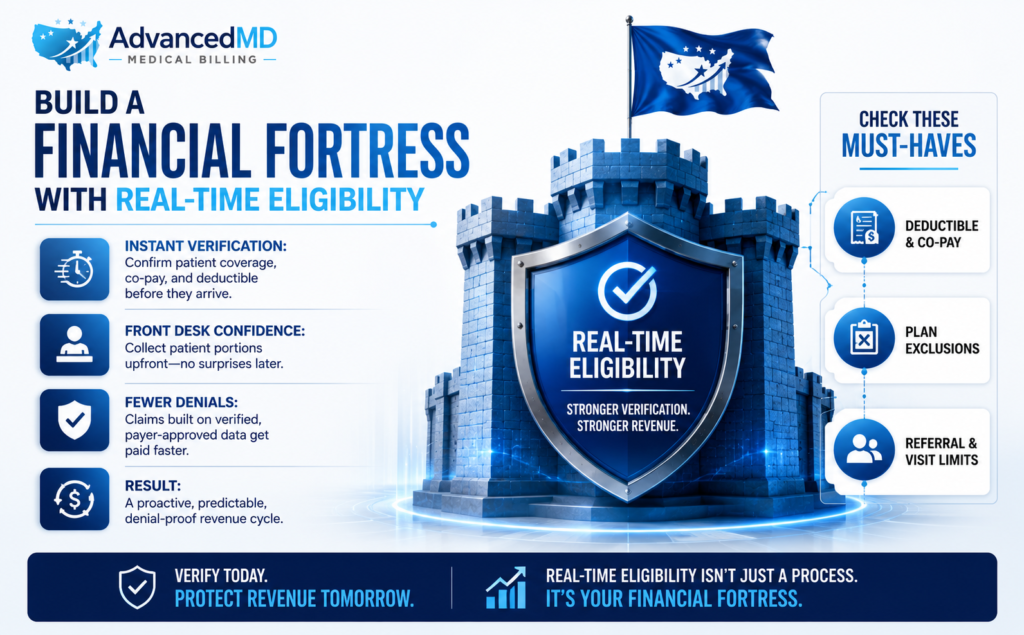
How Real Time Eligibility for Insurance Creates a Financial Fortress
Think of it as a digital shield for your revenue. It’s not magic it’s just smart technology working in the background, here’s how it works, without the confusing jargon.
When a patient books an appointment or checks in, your system automatically performs a real time insurance eligibility verification. It’s a seamless, instant conversation between your practice management software and the insurance payer’s database. No more waiting. No more batch files.
This process of real time eligibility for insurance is like a pre-flight check before the plane takes off. Right before the patient arrives, the system asks the payer: “Is John Doe still active? What’s his deductible? What’s his co-pay for today?”
And it gets answers. Instantly.
The system then pulls that accurate, real-time data—coverage status, patient responsibility, even authorization requirements—and places it right into the patient’s file. Your front desk staff sees it all clearly before they even greet the patient.
In practice, we see this transform chaos into control. There are no nasty surprises weeks later. Your team has the confidence to collect patient portions upfront because they have the correct numbers. The claim is built on rock-solid, verified information from the start.
It turns your revenue cycle from a reactive gamble into a proactive, predictable fortress.
Beyond Coverage: The Critical Data Points You MUST Check
Finding out a patient is “active” is just the tip of the iceberg, the real value—and the hidden denials—live in the details. A true eligibility and benefits verification digs deep.
Don’t just skim the surface, you must confirm:
- Deductibles: How much have they met? How much is left? This is non-negotiable for high-cost procedures.
- Co-pays & Co-insurance: The exact dollar amount or percentage. This is what you collect at the front desk.
- Plan Exclusions: Does their plan specifically not cover the service you’re about to provide? This is a denial waiting to happen.
- Referral Requirements: Is that “PCP referral” box checked? Without it, your claim is dead on arrival.
- Visit Limitations: Have they used up their allowed physical therapy or chiropractic visits for the year?
In practice, we see these specifics as the real-world financial traps. Knowing them transforms your eligibility and benefits verification from a simple check into a powerful financial tool. It gives you the confidence to collect what’s owed and file claims that stick.
Beyond Denials: The Overlooked Power of Real-Time Verification
Let’s be real, everyone talks about Real Time Eligibility as a denial-buster, and it is, but that’s like saying a sports car is good for getting groceries, you’re missing its true power.
First, think about your team’s sanity, how many hours are they on hold, playing phone tag with insurers? It’s soul-crushing work. We see the burnout firsthand. When you automate the grunt work, you give your staff their time and dignity back. They stop being detectives and start being ambassadors, that’s a game-changer for morale and retention.
Then, there’s the patient conversation. Right now, it’s often awkward. “Your insurance should cover this… we’ll bill you later.” That uncertainty breeds anxiety and those “surprise” bills destroy trust.
But with real-time data? You walk into the lobby knowing the exact co-pay. The conversation shifts from, “It might be $50,” to “Your co-pay today is $25, as confirmed by your insurer five minutes ago.”
That’s powerful. You’re no longer the bill collector. You’re a trusted guide. Patients appreciate the transparency, and that loyalty is priceless.
This technology becomes the nervous system of your practice. It transforms your front desk from a cost center into a profit center and a relationship hub. That’s the strategic advantage that goes far beyond the denial report.
Transforming Patient Financial Conversations
The money talk is the worst part of the day for your front desk staff.
They have to look a patient in the eye and say, “Well, we think your co-pay is $30, but we won’t know for sure until we bill you.” It feels flimsy. It makes your practice look disorganized.
Now, picture this instead.
Your staff member glances at their screen, sees the instantly verified data, and says, “Okay, Mrs. Davis, your insurance is all set. They show your specialist co-pay is $40 today.”
Boom. That’s it. No ambiguity. No awkwardness. It’s a statement of fact.
This changes the entire dynamic. You’re not haggling. You’re informing. For a bigger bill—like an unmet deductible—you can say, “I see your responsibility is $350. Let’s talk about how we can make that easy for you.” This is the moment to set up a payment plan, when the value of the service is right in front of them.
This transparency is a game-changer. It builds a kind of trust that marketing can’t buy. Patients know you’re on top of things. They feel respected. And you stop the vicious cycle of sending statements into a void, watching your A/R age.
Boosting Staff Morale and Efficiency
You know what burns out a great front desk person? Death by a thousand paper cuts. It’s the constant phone hold music, the confusing insurance codes, the feeling of being a detective instead of a caregiver.
But when you yank that tedious verification task off their plates? It’s like a weight lifts.
Suddenly, Susan from the front desk isn’t stressed about calling Blue Cross for the tenth time today. She’s free to actually talk to patients, smooth out the schedule, and solve real problems. She feels like a valued part of the team again, not a paperwork robot.
Quantifying the Win: The Real Time Eligibility ROI Your Practice Can’t Ignore
Let’s cut through the hype and talk numbers. Because when you’re considering any investment, the only question that matters is: “What’s my return?”
We’ve sat across from too many practice owners who’ve been sold software solutions that promised the moon but delivered barely a flicker. That’s why we need to get specific about what real time eligibility actually puts back in your pocket.
Think about your practice right now. How many staff hours are eaten up by phone verification? How many claims get denied for simple eligibility issues?
The math isn’t as complicated as you might think, let’s break it down with a real world scenario for a mid sized practice we’ll call “Central Health,” they see about 60 patients a day and were struggling with a 12% denial rate, half of which were eligibility-related.
Here’s what changed when they stopped guessing and started verifying in real-time.
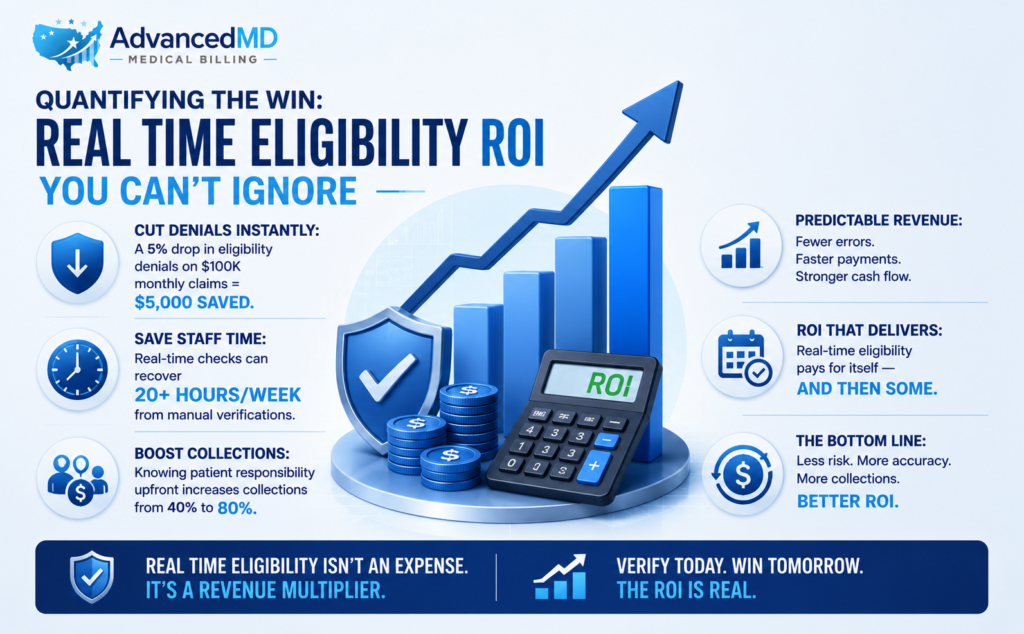
A Simple Framework to Calculate Your Savings
You don’t need a finance degree to run these numbers. Just grab your last month’s reports and use this formula:
1. Reduction in Denial Rate × Average Claim Value
If you cut eligibility denials by just 5% on $100,000 in monthly claims, that’s $5,000 back in your pocket immediately.
2. Staff Hours Saved × Fully Loaded Hourly Wage
If this saves your team twenty hours a week on phone calls and data entry, that’s over 1,000 dollars weekly in recovered productivity.
3. Increase in Point-of-Service Collections
When you know exactly what patients owe, collections can jump from 40% to 80% overnight. That’s real cash flow.
Add these three numbers together. Suddenly, that “cost” of implementation looks a lot more like the best investment you’ll make this year.
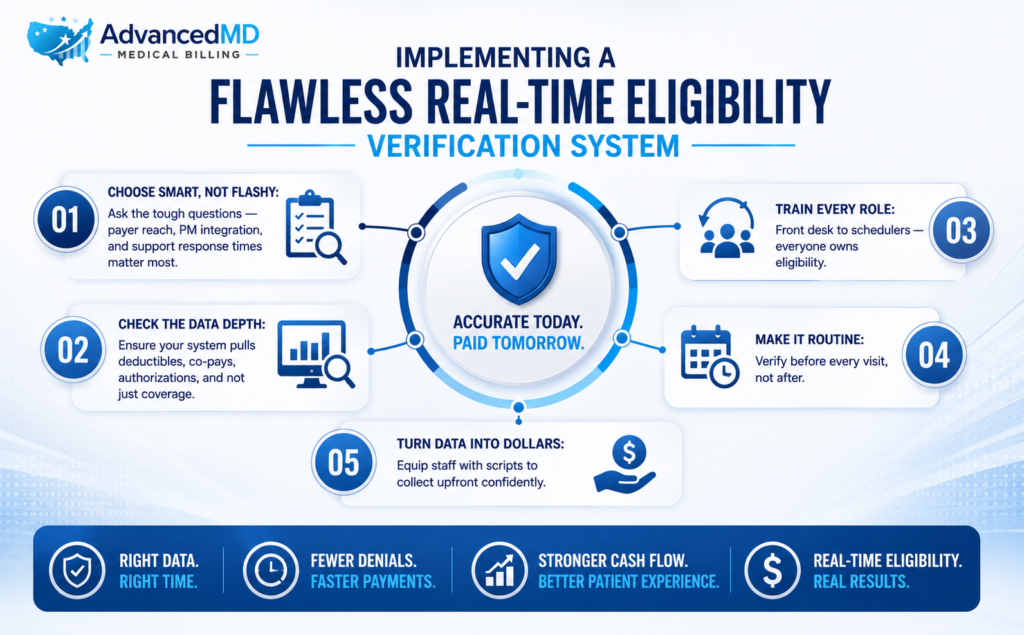
Implementing a Flawless Real Time Insurance Eligibility Verification System
Alright, you’re sold on the “why.” Now let’s get into the “how.” We’ve guided dozens of practices through this, and the key is to be a smart tech shopper.
Think of it like hiring a new key employee, you wouldn’t hire someone without checking their references and skills, right? Your real time insurance eligibility verification system is the same, it’s a core member of your team.
The goal isn’t just to buy software, it’s to seamlessly implement this tool into your daily rhythm so it feels like it was always there, meaning asking the right questions upfront and having a clear plan for your people, and the technology is the easy part, the real win is in the workflow.
Let’s break down into the following:
Five Must Ask Questions When Choosing a Vendor
Don’t get dazzled by a fancy demo, get answers.
- “How deep is your payer network? Are there any major payers in our area you have trouble connecting with?”
- “Walk me through the integration with our PM system. Is it a true, seamless connection or a clunky add-on?”
- “What does your support look like? If we have an issue at 10 AM on a Tuesday, what happens?”
- “Can you show me the reporting? I need to see denial rates and POS collections at a glance.”
- “Beyond basic coverage, what specific data points like deductibles and authorizations do you reliably pull?”
Their answers tell you everything about whether they’re a true partner or just a vendor.
Best Practices for Workflow Integration
Technology is useless if your team doesn’t use it, here’s how to make it stick.
First, train everyone—not just the front desk. Your clinical schedulers need to understand this new patient eligibility verification process too. Make it a non-negotiable standard: every single appointment gets checked.
Then, build the new habit. The check should happen during the pre-appointment prep or the moment the patient checks in. Don’t let it be an afterthought.
Finally, use the data you get. Arm your front desk with a simple script, when the system shows a $40 co-pay, they say, “Your co-pay today is $40.” It’s that direct. This turns data into action and action into collected revenue.
Final Thoughts
Let’s be clear: the old way is broken, chasing down denials and begging for payments isn’t a revenue cycle—it’s a revenue trap.
Real Time Eligibility isn’t just another piece of software. It’s the fundamental shift your practice needs to stop fighting yesterday’s battles and start securing tomorrow’s revenue today. This is about moving from a reactive posture—constantly putting out fires—to a proactive one where you build a financial fortress that prevents those fires from ever starting.
We’ve seen the transformation firsthand. It’s the difference between your staff dreading the phone and confidently collecting what’s owed. It’s the difference between surprised, frustrated patients and trusting, informed partners in their care.
This isn’t a luxury anymore, it’s the baseline for a healthy, modern practice, and you have a choice: keep reacting to the same old problems, or finally prevent them. The power to choose is right there.
Your Next Step with AdvancedMD Medical Billing
You’ve seen the numbers. You know the cost of the status quo.
Now, let’s pinpoint your exact leakage. Forget the generic sales pitch.
Book a Free Eligibility Process Audit with our team. In 30 minutes, we’ll analyze your current denial data and staff workflow, you’ll receive a customized, one-page roadmap showing your potential savings and the exact ROI you could achieve.
No strings. No pressure. Just a clear path to turning your revenue cycle from a cost center into a profit engine.
Click here to claim your audit slot. Let’s stop the bleed, together.
FAQs
Isn’t “real time eligibility” just a fancy term for what my staff already does manually?
No, it’s a fundamental upgrade. Think of it as the difference between using a landline and a smartphone. Both make calls, but one does it instantly, with more data, and connects seamlessly to everything else you use, and manual checks are slow, prone to human error, and use outdated data, real time eligibility is an automated, instant connection to the payer, giving you accurate information right when you need it most.
How much does a system like this actually cost?
This is the wrong first question—and we say that as your financial partners. The right question is, “What is my current ‘verify-and-pray’ system costing me?” You’re already paying for it in staff hours, claim rework, and lost cash flow. The ROI is usually clear once you calculate denied claims and administrative waste. We help practices see this exact number in a free audit, so the investment decision becomes a no-brainer.
Will this slow down my front desk during patient check-in?
It should do the exact opposite. In practice, we see it speeds things up dramatically. The check happens automatically in the background before the patient even arrives. Instead of a 5-minute conversation fumbling through benefits, your staff has a one-second confirmation of the co-pay. It turns a complex discussion into a simple transaction.
What if the real-time data is wrong? Who is liable?
This is a common and valid fear. The data comes directly from the payer’s system, making it the most reliable source available. It’s far more accurate than a week-old batch file or a phone agent’s interpretation. In the rare event of a discrepancy, the EOB from the payer is the final word. The system drastically reduces errors; it doesn’t eliminate the payer’s ultimate responsibility.
We’re too busy to implement new software right now. Is the disruption worth it?
We get it. You’re fighting fires every day. But this is about handing you a better fire extinguisher. A good partner handles the heavy technical lift and integrates directly into your existing practice management system. The goal is to create a seamless workflow that feels native within a week, the short term adjustment is a small price for permanently ending the daily chaos of eligibility denials.